Migrant Resource Match
MRM is an AI-enabled, community-centered platform for migrant support services.
A research project at DePaul University, MRM was initiated by the DePaul AI Institute and the DePaul Migration Collaborative, and is supported by the U.S. National Science Foundation's ReDDDoT program. The goal of the is platform to help migrants navigate employment, housing, healthcare, legal aid, and other essential services, and to help migrant-serving organizations manage rising caseloads. The work advances two areas of research: responsible AI development through a community-centered participatory design process that engages migrants, service providers, and trained community Champions across every stage of development; and fairness-aware recommender systems that combine collaborative filtering, knowledge graphs, and content-based methods with group-fairness metrics to produce equitable, personalized recommendations.
 Assess needs through multilingual interviews
 Translate & extract key information
 Match migrants to relevant services
 Recommend fairly & transparently

Collaborative
Rising migration is straining city services and the organizations that support migrants.
In cities such as Chicago, the arrival of tens of thousands of asylum seekers has placed pressure on public agencies and nonprofit networks. Migrants encounter several overlapping barriers to essential services.
Reported consequences include misaligned placements, wasted resources, and community tensions.
Four stages, from understanding a need to a matched service.
The platform under development integrates multilingual language technology with a hybrid recommender system. It is designed to move from a migrant's own description of their situation to a fair, personalized set of service recommendations.
Stage 01AI-driven needs assessment
Multilingual interviews capture a migrant's situation, drawing on needs-assessment experience at the DePaul Migration Collaborative.
Stage 02Translation & data extraction
Documents and conversations are translated and structured into formats that existing service systems can use.
Stage 03Personalized service matching
A hybrid recommender tailors suggestions to individual preferences, constraints, and protected attributes.
Stage 04Fair, transparent recommendations
Group-fairness metrics and human review keep recommendations equitable across subgroups, with documented processes.
Stakeholder input is incorporated across every phase.
Rather than consulting users only at the start and end, the process keeps stakeholders and trained community Champions engaged through design, development and testing, and deployment, with a Stakeholder Advisory Board providing oversight throughout.
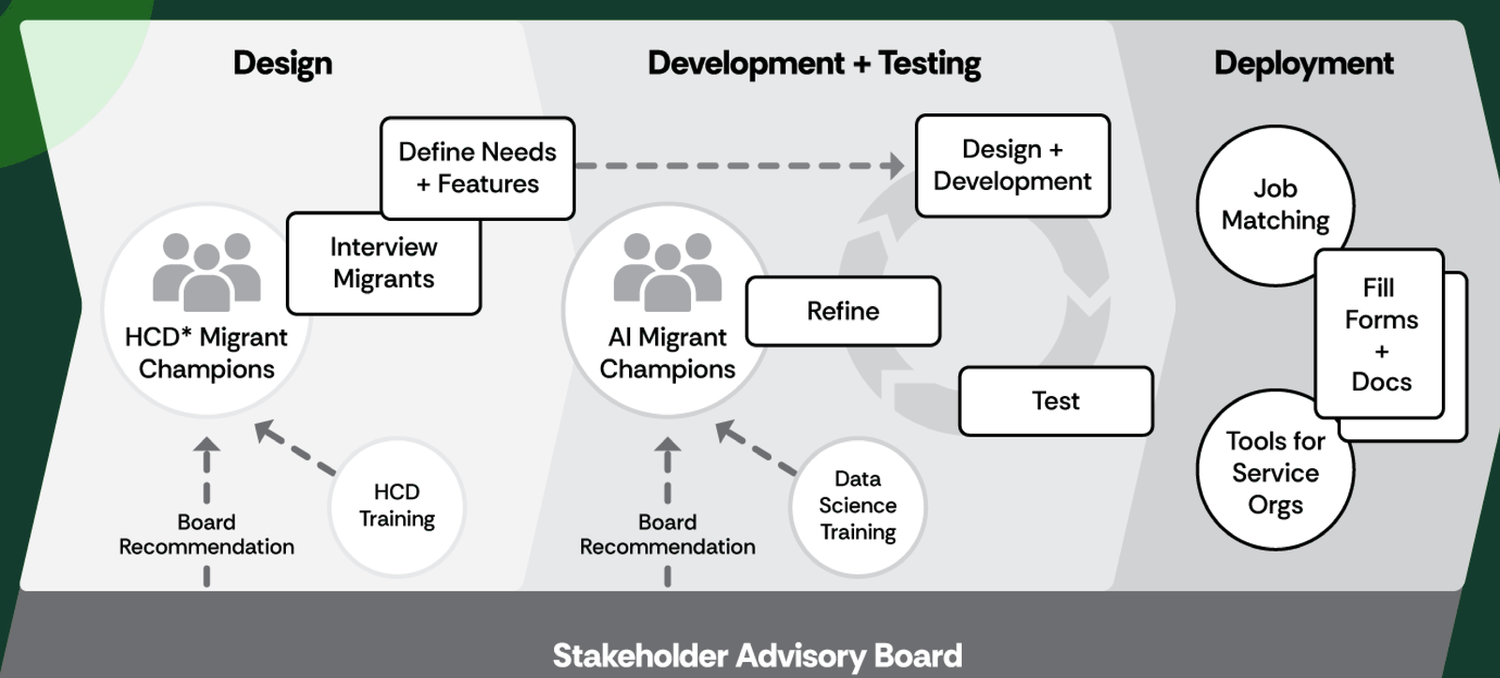
HCD = human-centered design. Adapted from the project overview.
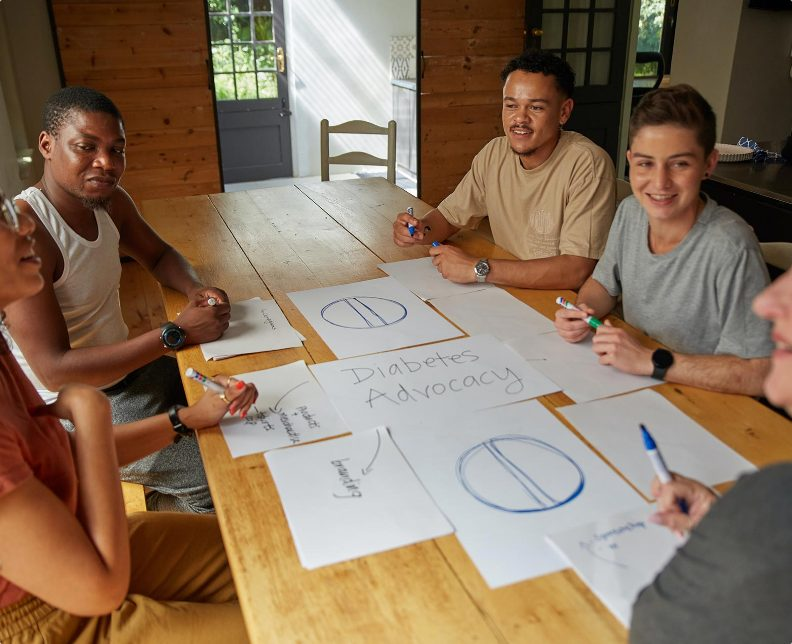
Community-centered participatory design.
The project extends human-centered design so that community input shapes ideation and prototyping, not only requirements-gathering and final testing. The design model has four components. Select each to read its description.
Stakeholder Advisory Board (SAB)
Guides project goals, ethical standards, and risk identification to align development with community values. The board includes representatives from migrant communities, nonprofit organizations, local government, and service providers.
Select a component above to view its role in the design process.

Fairness-aware recommender systems.
The recommendation component is developed specifically for a sensitive, multi-stakeholder context, with explicit attention to model bias and group fairness.
Hybrid model architecture
Combines collaborative filtering, knowledge graphs, and content-based methods to produce context-aware recommendations.
Group-fairness metrics
Fairness criteria are integrated into model training and post-processing so that outcomes are equitable across subgroups defined by attributes such as nationality, language, or legal status.Demographic parityEqualized odds
Human-in-the-loop oversight
Champions and service providers review and re-rank outputs and inform model retraining, supporting continuous evaluation.
Multi-stakeholder fairness
Recommendation processes account for the interests of migrants, providers, and system-level constraints simultaneously.
Fairness in this setting extends beyond individual-level accuracy to group fairness, ensuring outcomes are equitable across subgroups of migrants. The framework also considers intersections of multiple attributes, such as gender and cultural background, to reduce the risk of compounded bias.
For example, in employment matching the system is designed to balance opportunities between higher- and lower-skilled migrants, rather than concentrating access within a single group. Protected attributes are flagged so that they do not disproportionately influence recommendations.
Privacy, transparency, and real-world evaluation.
Working with sensitive data and vulnerable populations requires deliberate safeguards. Four commitments are built into the design.
Privacy by design
Differential privacy and federated learning are used to minimize data exposure while still enabling analysis.
Transparency
Recommendation processes are documented to support accountability and user confidence.
Cultural responsiveness
Interfaces are co-designed with Champions to fit users' linguistic, social, and cultural contexts.
Outcome evaluation
Evaluation considers real-world outcomes, such as employment and housing stability, alongside model accuracy.
Designed to benefit several groups, and to be adaptable elsewhere.
The project examines how AI, paired with ethical frameworks and community partnership, can support service delivery. Its intended benefits span four groups.
Migrants
- Tailored access to resources
- Support for skill development
- An active voice in platform design
Organizations
- Reduced administrative burden
- More streamlined intake
- More efficient use of limited resources
Policymakers
- A replicable responsible-AI model
- Efficiency balanced with fairness
- Accountability and transparency
Other cities
- A scalable, adaptable framework
- Cross-jurisdictional learning
- Local adaptation with retained safeguards
Partner organizations shaping the platform.
These community and non-profit organizations have partnered with Migrant Resource Match. They are represented on the MRM Community Advisory Board and provide ongoing feedback into the design and development of the platform.
Ways for organizations to contribute.
The project relies on broad community participation to keep its tools relevant and ethically grounded. Migrant-serving and civic organizations can contribute in four ways.
Join the Stakeholder Advisory Board
Help shape project priorities, guide ethical considerations, and ensure community perspectives inform decisions.
Partner with us
Help support the project by providing organizational, financial, or infrastrcuture support to fully develop and operationalize the platform.
Share anonymized data
Contribute non-sensitive, anonymized historical data, under strict privacy protections, to improve relevance.
Provide prototype feedback
Validate functionality, identify usability challenges, and suggest refinements for accessibility and cultural fit.
Project team & contact.
For partnership, advisory board, data-sharing, or media inquiries, please contact the project manager. The project is based at DePaul University in Chicago.